
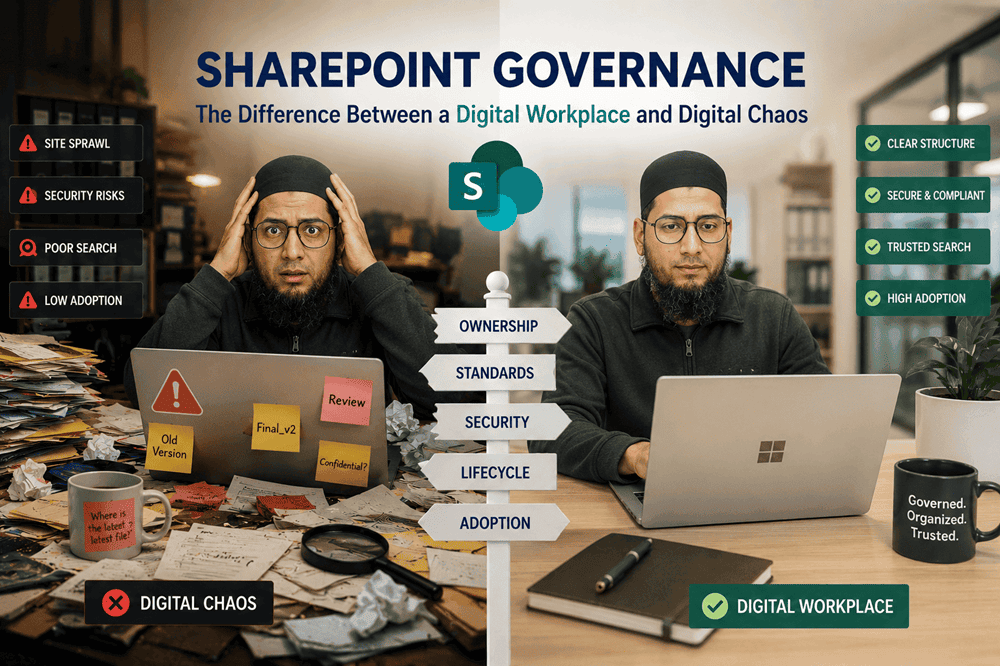
SharePoint Governance: The Difference Between a Digital Workplace and Digital Chaos
SharePoint Governance:
The Difference Between a Digital Workplace and Digital Chaos
The missing foundation behind successful SharePoint environments
The Story Continues…
In my previous article, “When SharePoint Becomes a Digital Junkyard”, we explored how poor document management slowly creates confusion, duplication, and frustration.
Poor document management is usually not the root problem.
The real problem is often something far less visible:
The Story
In the beginning, everything felt like a win.
The company finally launched SharePoint. The IT team celebrated — months of planning, migration, and testing had paid off. Departments cheered because they finally had a place for everything.
And for a while… it worked.
Teams created their sites. Projects spun up their workspaces. Documents flowed in. Everyone felt productive.
But slowly, quietly, the cracks began to show.
Marketing couldn’t find their campaign site, so they created a new one. HR built three different libraries for the same process. Project teams finished their work but never archived anything. Old sites stayed alive like abandoned buildings no one wanted to enter.
Permissions became a free-for-all. “Just give Everyone access — we’ll fix it later.” Later never came.
Documents piled up. Versions multiplied. Search results became a graveyard of outdated files. People stopped trusting what they found.
And one day, someone asked the question no one wanted to hear:
But SharePoint wasn’t the problem. It was doing exactly what it was told to do.
The real issue was that no one was telling it how to behave.
No rules. No structure. No ownership. No lifecycle. No governance.
And without governance, even the best platform becomes chaos.
What Is SharePoint Governance?
Many people think governance means restrictions.
It doesn’t.
Good governance is not about blocking users. It is about creating clear rules, ownership, standards, and accountability so that SharePoint can grow without becoming unmanageable.
Without traffic rules, even the best roads become dangerous.
Without governance, even the best SharePoint environment becomes chaotic.
The Hidden Costs of Poor Governance
1. Site Sprawl
- Anyone can create sites
- Nobody deletes them
- No one knows which site is official
- Finding information becomes difficult
2. Security Risks
- Excessive permissions
- Former employees still own sites
- Sensitive data remains exposed
- Compliance becomes difficult
3. Search Becomes Unreliable
When documents are stored inconsistently, named differently, and classified poorly, users stop trusting search results.
4. Adoption Starts Declining
Users rarely complain. Instead, they create workarounds.
- Local folders
- Personal cloud storage
- Email attachments
- Shadow IT solutions
The Five Pillars of Effective SharePoint Governance
1. Ownership
- Business Owner
- Backup Owner
- Defined Responsibilities
2. Information Architecture
- Site Hierarchy
- Metadata Standards
- Naming Conventions
- Content Types
3. Site Lifecycle Management
- Creation Policies
- Review Schedules
- Archiving Procedures
- Deletion Policies
4. Security Governance
- Role-Based Permissions
- Access Reviews
- Sensitive Content Controls
- Ownership Validation
5. User Adoption and Training
- Training
- Communication
- Clear Standards
- Ongoing Support
Governance in the Age of AI
As organizations adopt Microsoft Copilot and AI-powered search, governance becomes even more important.
AI can only provide accurate answers when the underlying content is:
- Structured
- Secure
- Classified
- Trustworthy
It Exposes Them.
Final Thoughts
Many organizations invest heavily in SharePoint technology. Few invest enough in SharePoint governance.
Technology creates the platform. Governance creates the value.
If your employees struggle to find documents, question search results, duplicate content, or avoid SharePoint altogether, don’t start by blaming the platform.
or do we just have SharePoint?
Because the difference between a modern digital workplace and a digital junkyard is usually not the technology.
It’s Governance.